
How it started
In Nigeria, smallholder farmers grow over 80% of the country’s food, but only 7% receive any formal support. Most rely on traditional knowledge or guesswork to decide what to plant, how to grow it, and where to sell. Without access to good advice, markets, or storage, they often lose 40 to 60 percent of their harvest.
Yields stay low, incomes stay low, and the cycle repeats. Kitovu was created to break this cycle.
Launched in 2019 with a three-person team, the company set out to help farmers grow more, waste less, and earn better by giving them access to the inputs (tools, data, storage, and market access) they need.
But Kitovu quickly realized that most farmers couldn’t afford to pay for one-off services. So the team adjusted its approach. Instead of selling services separately, they bundled them together. Farmers receive inputs like seeds and fertilizer along with expert advice, they can store their harvests in Kitovu’s facilities, and even use that stored produce as collateral to access financing. Kitovu also helps farmers sell to buyers and earns a small commission on each sale.
This end-to-end support model created more value for farmers and required a larger team to deliver it. As demand grew, Kitovu brought on field staff, crop specialists, and operational support to reach more farmers across more regions. Today, Kitovu has a 27-person team working across Nigeria.
Kitovu’s organizational structure
To stay agile and farmer-focused, the company uses a semi-flat structure.
“One of the things I worry about most is bureaucracy,” says founder Emeka. “I want to be able to get things done without having chains of communication, because I think a lot gets lost in transmission.”
That philosophy is reflected in how Kitovu is structured today.
Kitovu has two core types of teams:
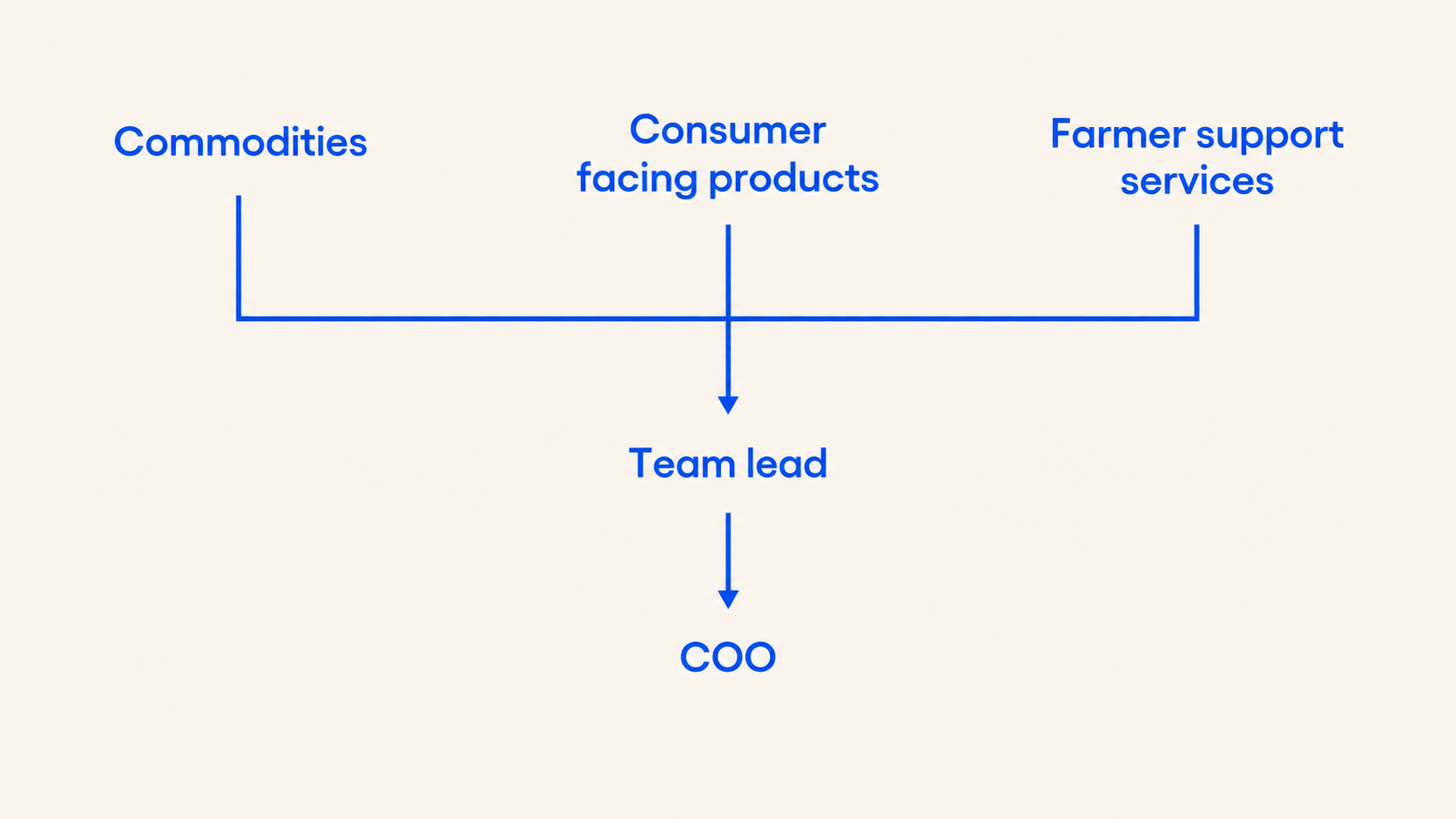
Product teams that focus on key business areas such as farmer support, B2B commodities, and direct-to-consumer sales. Each team is led by a team lead who reports to the Chief Operating Officer (COO).
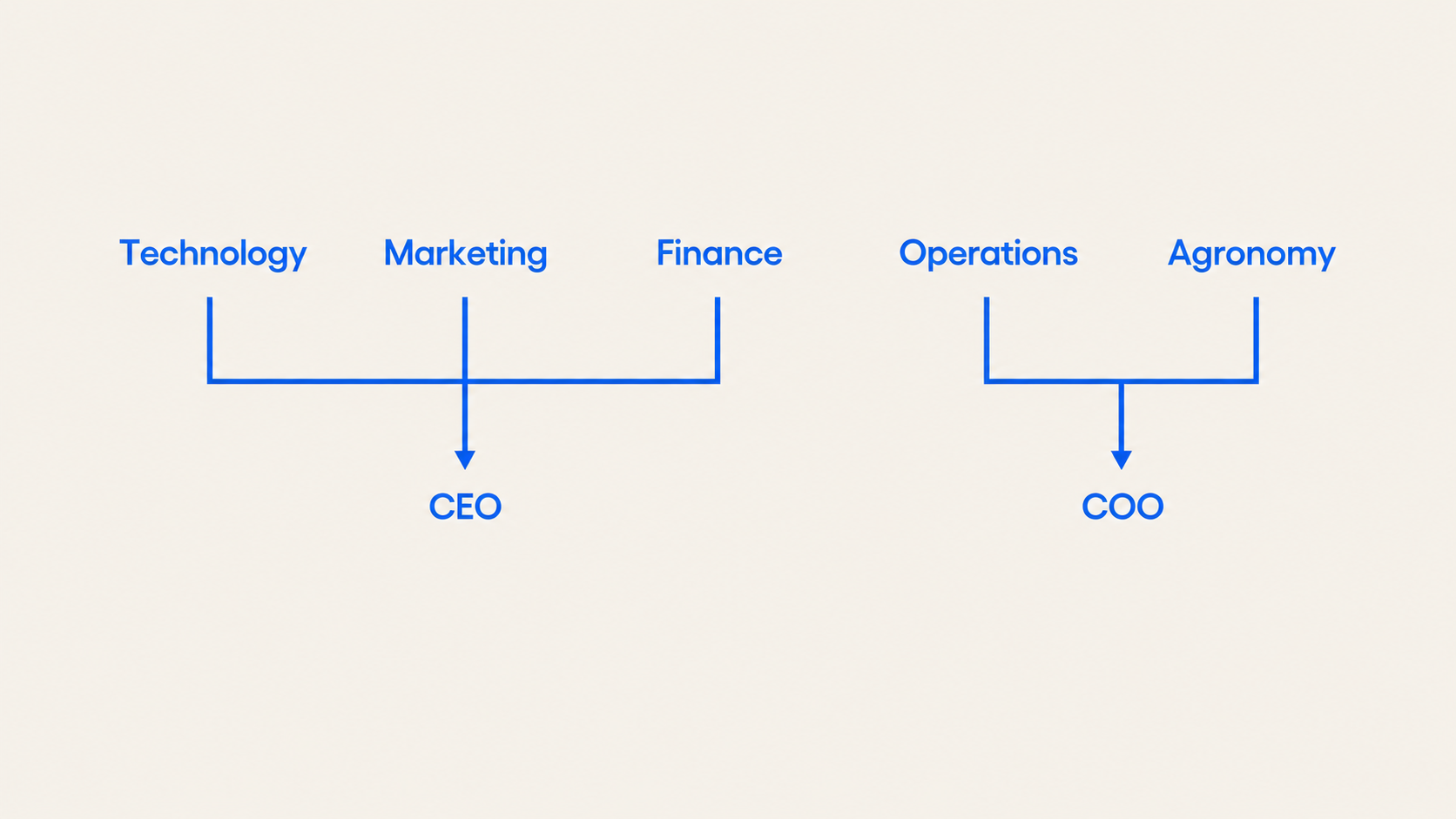
Cross functional teams include departments like finance, technology, marketing, operations, and agronomy. These teams support the entire organization and report to either the Chief Operating Officer or the CEO.
This hybrid structure helps Kitovu stay lean, responsive, and aligned with its mission to build farmer-centered innovations that scale.
How is your team currently structured?
Is your setup helping or hindering your ability to stay responsive to your mission?
Recognizing the need for structure
Emeka’s leadership philosophy began with a simple idea: build a fun, loving work environment that attracts people who are genuinely passionate about the mission.
“When you are passionate about something, you automatically commit to it,” he explained.
In the early days, with a small, mission-driven team, that belief held true. The energy was high, and everyone was eager to contribute. But as the team grew, cracks began to show. Some people carried more weight than others, performance wasn’t being tracked, and informal feedback loops fell short.
The team was working hard, ambitious targets were being set, but the results didn’t reflect the effort. He recognizes that although they were doing a lot, nothing really added up. And he began to see the limits of passion alone. He realized that unbridled passion could break things.
One moment brought this into sharp focus. The team of seven had set out to build a pipeline of farmers. By the end of the year, they had done the work, but the farmers onboarded were spread across different regions and value chains, many of which didn’t fit Kitovu’s market-first strategy1. Some were located in places the company couldn’t support effectively.
Each person had taken their own approach, and the lack of alignment made the effort ineffective. He reflects that there was a lack of coherence and alignment around a singular objective. That experience was a turning point. Emeka realized that without structure, the organization risked pulling itself apart. Passion was important, but it had to be paired with clarity, focus, and coordinated execution. Reflecting on a podcast by Dil Leon, he put it simply:
"Sometimes when you are trying to run an enterprise, it’s like you get a bus. As a founder, you're responsible for getting the right people on the bus and deciding where the bus is going. If you give free rein, no structure, no organization, you might have people in the bus wanting to go in different directions.”
A formal performance system, he now saw, was not just helpful. It was essential.
1 A market-first strategy means starting with confirmed demand from buyers, then organizing farmers to grow exactly what the market needs.
Are your team's efforts aligned with your strategy?
What would a performance system help you see more clearly?
Overcoming implementation challenges
When Emeka first introduced a performance management system at Kitovu, it was not well received and the resistance was constant. And it didn’t come from just one part of the team. It came from all sides.
Top performers were among the loudest critics. Many of them felt they were already delivering results and didn’t see the point of attending check-ins or submitting updates. “I’m getting things done,” was the common refrain. Field teams, especially those working in commodities and supply, found the new system difficult to integrate into their fast-moving routines. It felt unnecessary and out of sync with how they operated.
Additionally, the system required a shift in how they worked. It introduced more documentation, more structure, and clearer expectations. For some, it meant changing routines they had grown used to. Across the board, there was discomfort with the idea of working in a more defined and visible way.
Emeka tried different approaches to get the system off the ground. First, they used simple tracking tools like shared spreadsheets. Then, they used an app where team members could log their activities in real time. But none of it worked. People didn’t engage with the tools, and the resistance continued.

Making the system their own
For Emeka, building a performance system wasn’t just about setting rules; it was about building trust. And that meant listening, adjusting, and making room for people to shape the system with him.
“As a founder, you can’t just think, ‘Because I designed this process, everyone should fall in line.’ It doesn’t always work that way,” Emeka explained. “You have to engage your team, not to dismiss what they’re saying, but to understand what in the system might actually be blocking them. That’s how you build something better that still meets your objective, while giving them the flexibility to do what they need to do.”
By treating the performance system as a shared tool rather than a top-down mandate, Emeka helped the team feel like co-creators. And when people feel ownership, they engage.
Tying it to the mission and values
At Kitovu, performance management wasn’t just a tool, it was a reflection of what they stood for. Kitovu’s mission involves systems change, which is a huge and complex undertaking. That level of transformation couldn't rely on individual heroics or informal coordination. It needed systems.
As Emeka told the team, “It takes systems to organize processes. It’s not about you. It’s not about me. You need to build an organization that can run whether you’re there or not.”
Kitovu’s culture is anchored on five core values: service, agency, loyalty, urgency, and tenacity. Emeka used these values to frame why the system mattered.
If urgency was part of the culture, then it had to be visible in how people showed up, how they prioritized, and how they executed, not just in how passionate they felt. If loyalty and agency mattered, then people needed to contribute to something bigger than themselves, in ways that were trackable and transferable.
“I know you love this organization and what you're doing,” he said, “but you need to build a system such that, even if you move to another role, somebody else can come in and not have to start from scratch.”
By tying the team performance management system to both the vision and the values, Emeka shifted the narrative. This wasn’t a rigid system imposed from above. It was an enabler, a way to scale excellence, protect culture, and build an organization that could endure.
That framing helped the message stick. Slowly, resistance gave way to participation. The system wasn’t perfect, but it started to feel like something the team could shape, and something that could shape them in return.
Where are your team’s biggest points of friction?
Could co-creating your systems help overcome resistance?
Kitovu’s performance system today
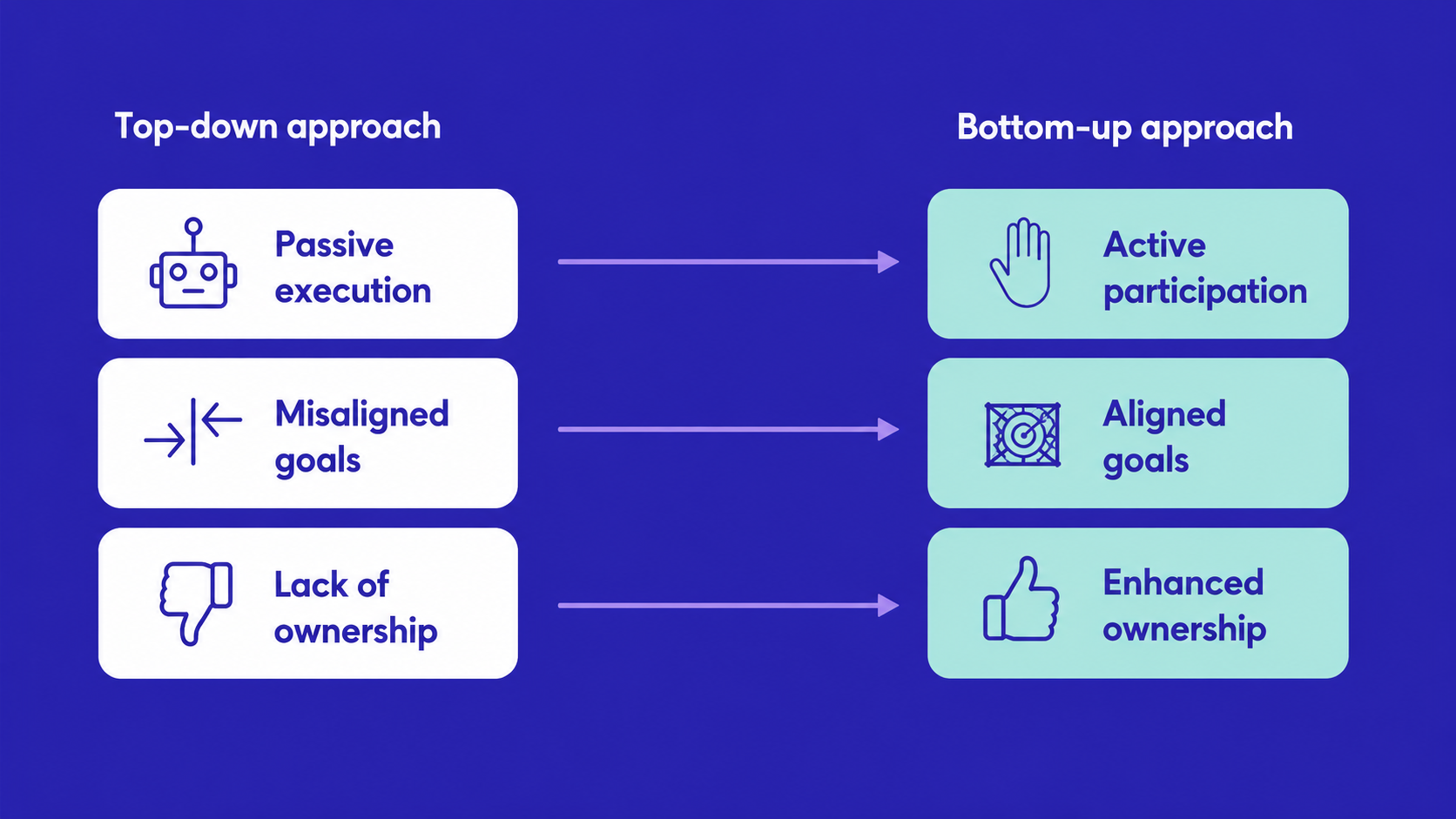
Kitovu didn’t get performance management right the first time. Initially, the team rolled out OKRs2 the traditional way, with top-down goals, shared across the company, with an expectation that people would execute. But something didn’t click.
“We just came in and we’re like, oh, we’re going to be doing OKRs… this is how OKR works, and that was that,” Emeka shared. “At the end of the day, people set goals, but they were not connected to the goals. There was no sense of ownership.”
The system was overwhelming. Goals felt imposed. Many key objectives were left unmet.
The turning point came with a realization. If you want people to commit to goals, they have to help shape them.
2OKR stands for Objectives and Key Results is a goal-setting framework used to define clear objectives and measurable outcomes to track progress and drive organizational alignment.
A shift to bottom-up goal setting
Kitovu pivoted to a bottom-up approach. Now, the year begins with a strategic retreat. Senior leadership sets the broader direction, defining the mission, the why, and the where. From there, product teams translate that vision into their own OKRs, which are then broken down to departments and individuals.
"When people shape the targets, they fight for them," Emeka says.
This shift created clarity. It gave people a line of sight from the company’s long-term mission to the small tasks they handle each day. And it created ownership. People no longer felt like they were executing someone else’s plan. They were driving it themselves.
A top-down vs. bottom up approach to performance management:
The key components of Kitovu’s performance management system
The year begins with an all-hands retreat where the team meets to reflect and reset. Senior leadership sets the strategic direction; teams break that into focused, product-level goals.
Goals are broken down from annual to quarterly, monthly, weekly, and even daily tasks. Tasks and objectives are assigned to individuals using the RACI model (which allocates people to a task based on whether they are Responsible, Accountable, Consulted or Informed) to clarify responsibility, everyone knows who owns what.
Performance is tracked through layered reviews:
Daily standups within each team keep teams aligned and focused.
Weekly check-ins help the team lead spot blockers early and course correct.
Monthly reports reflect on what’s working and where support is needed.
Quarterly reviews to zoom out to assess OKR progress and reset priorities.
Quarterly Reports that are then submitted to the Board.
Each level builds on the last, creating a rhythm that keeps teams proactive and adaptive.
At Kitovu, values (Service, Agency, Loyalty, Urgency, Tenacity) matter just as much as hitting targets. They’re part of everyday work, showing up in standups, reviews, and how people collaborate. It’s not just about what you achieve, but how you go about it. One of the ways the team keeps this front and center is through a weekly ritual called “Tribes-on-deck,” where team members get shout-outs for living out the values in real, tangible ways.
At Kitovu, individuals have monthly performance evaluations that are all about growth. When someone isn’t meeting expectations, the question isn’t what went wrong, but what’s missing. It could be a skills gap, a role mismatch, or just a need for more clarity. Support might look like coaching, a new role, or a recommended book or course. These checkpoints also help spot wider patterns, leading to team-wide training. The focus is on helping people get better!
How do you currently track progress in your organization?
What rhythm of review or feedback would help your team stay aligned and adaptive?
The payoff
“If people know what they’re doing, the likelihood that they’ll enjoy it, and the odds that they’ll stay - increases,”
said Emeka, reflecting on why his team introduced a formal performance management system. What began as a tool to structure performance quickly evolved into a core part of their growth strategy. The goal was clear. They aimed to build a culture of ownership, improve execution, and retain top talent.
Culture of accountability and ownership
By involving team members in setting and reviewing their own goals, the team shifted from being passive contributors to active owners of their work. “There’s a very, very increased sense of ownership, especially since our performance management approach is more bottom-up, so there’s that feeling of, ‘We are going to get this done’...So yeah, I mean, I can go to sleep.” This sense of shared accountability turned strategy into action. It wasn’t just about what was on paper - it was about execution at every level of the team.
Better communication, improved execution
The system also transformed how the team communicates and collaborates. “We’re able to communicate past information better, which means that improved performance as a team individually and as a whole,” Emeka shared. The structure created space for feedback, clarity, and continuous improvement. The impact was clear: business outcomes like revenue improved, and the team became more efficient and proactive. With clear expectations, people took initiative and focused on solving problems rather than waiting for direction.
Higher retention, better fit
Beyond performance, the system helped improve how the organization supports its people. Underperforming team members were coached, repositioned, or, when necessary, exited with clarity and fairness. As Emeka put it, “By the time you're doing performance management and you're identifying periods of change, outlining them... it's clear to the person that it's not a witch hunt. It's clear that you're doing this to help the person become better, and ultimately, it also helps you ensure the person is in the right place.” The result? A 95% retention rate in a sector where turnover is common. That stability has become a quiet strength, enabling deeper trust, continuity, and long-term impact.
Closing thoughts
To other social entrepreneurs, Emeka's advice is clear: "First, I'll tell them to do it yesterday. If you didn't do it yesterday, today is fine too."
He urges leaders to explain the purpose behind the change: "Start with why. There has to be an understanding of why. The team, they are not [clueless]. If they were, you wouldn't have hired them. So you need to make sure that they understand why you want them to do that right."
And finally, he adds, "Be ready to fail. Most performance management [efforts], they don't work on the first try. You have to keep at it. Keep working until it works."
Key takeaways
Start early, iterate often. Don’t wait for the “perfect” system to begin building your performance framework early, even if it's simple. Use real-time feedback and outcomes to refine it over time.
Resistance isn’t rejection, it’s insight. When team members push back, listen closely. Small, early adjustments based on their feedback can reduce friction, increase trust, and create systems that people actually want to use.
Build from the bottom up to build buy-in. Shift from top-down mandates to collaborative goal setting. When people shape the goals, they feel ownership over the outcomes. This sense of agency fuels accountability, strengthens culture, and drives long-term performance.