How it started
By 2015, India had made substantial progress in expanding electricity access across the country. However, many households still lived in darkness after sunset, children struggled to study, families relied on hazardous kerosene lamps, and rural clinics operated without reliable power. Electricity is the foundation for progress, yet millions remained excluded.
By the time the 2011 Census rolled around, only 55.3% of rural households had access to electricity in comparison to the 92.7% of urban households. In Rajasthan, a state with a predominantly rural population, power supply was far from reliable.
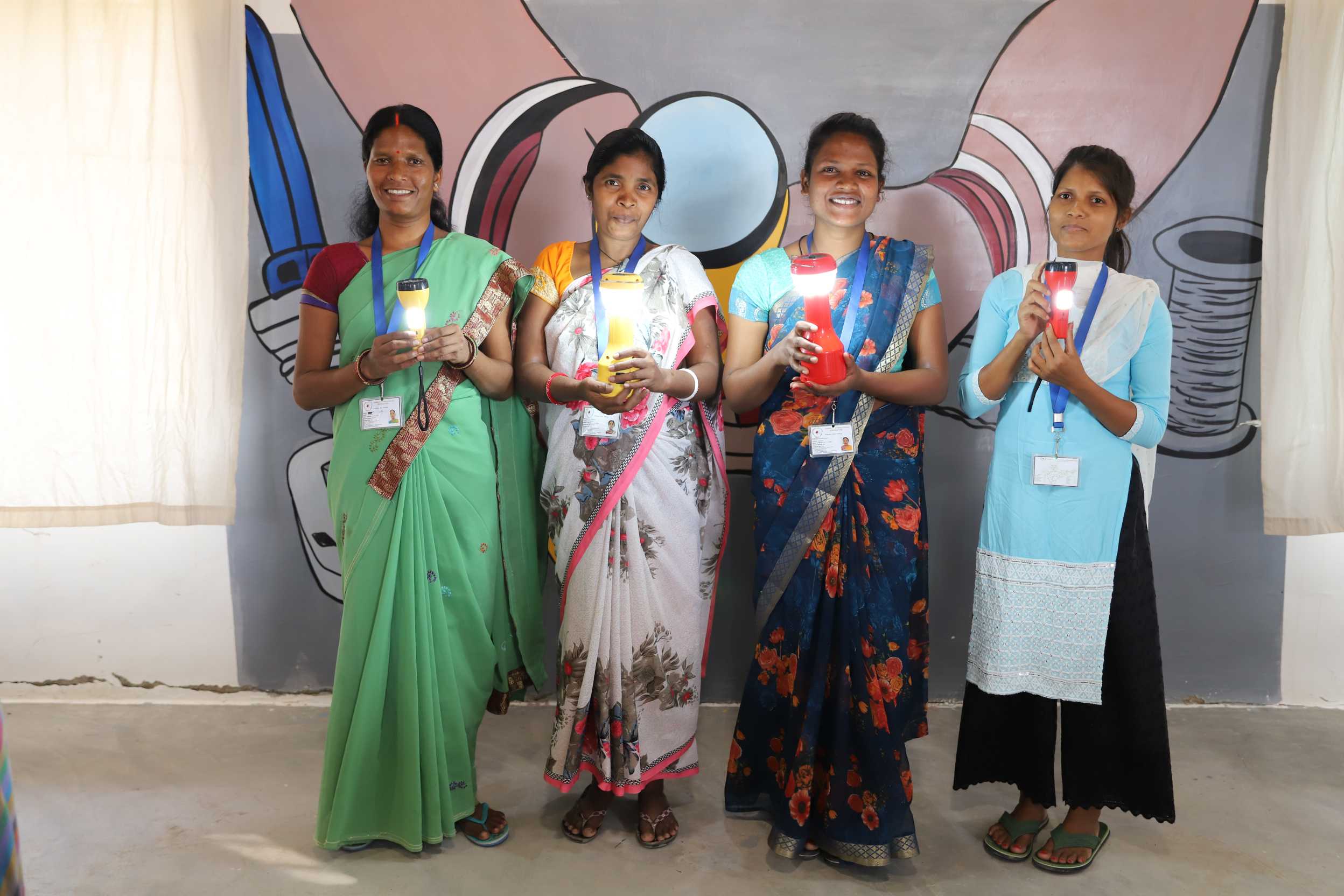
Bindi International was founded with a simple belief: for development to take root, communities first need sustainable energy – and women must be at the center of that change. “We wanted to break this notion that technology is only for cities and college graduates, and instead place it in the hands of rural women,” says Harsh Tiwari, Director of Bindi International and 2023 Acumen Academy Accelerator Participant.
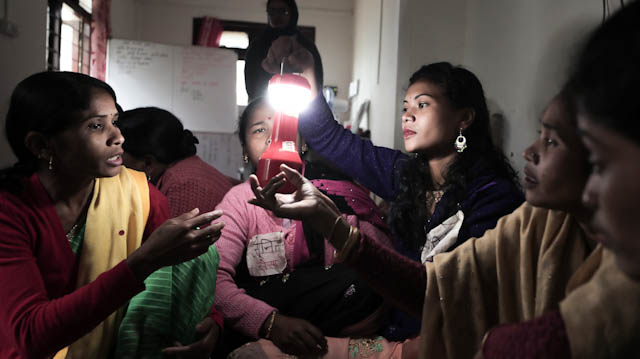
Through donor and CSR1 funds, the organization started by providing 40-volt home lighting systems so families were no longer in darkness or dependent on kerosene. But this was never just about electricity. Training women as solar engineers created a different kind of psychological impact: when a woman returned home and electrified her village, people began listening to her voice in new ways. As Harsh puts it, “Because she controls the light, she also gains the space to say what she feels needs to be done for her family or community.”
Electrification was the entry point, a milestone achieved upon seeing villages experience the benefits of consistent power.
1 CSR (Corporate Social Responsibility) refers to companies funding or supporting social and environmental initiatives as part of their responsibility to society.
Community demand sparked a new opportunity
The donor-funded electrification program achieved its primary goal – but success sparked something unexpected. "The women engineers we had trained and the women from the houses we electrified came to us and wanted to understand how this technology could be used to improve their livelihoods," recalls Harsh Tiwari. They weren't asking for more lights. They wanted for solar-powered tools such as solar pumps, refrigerators and microgrids, for their livelihood activities which included papad making, basket weaving, atta chakkis2, food drying, refrigeration and agriculture.
While these "aspirational" tools could transform household economics, they were beyond the scope of Bindi’s philanthropic model. Their donors primarily prioritized breadth – electrifying as many villages as possible. In contrast, their community wanted depth – tools that could power their livelihoods. Thus, there was a significant tension between Bindi's donor-driven model and what their customer truly valued.
Committed to responding to those needs, Bindi set out to explore a new business and operating model that could grow directly from what the community had asked for.
2Atta chakki refers to a small flour mill used to grind whole wheat (and other grains) into fresh atta (whole-wheat flour)
Testing demand and launching a for-profit
To move forward, Bindi first needed to test whether the interest they were hearing could translate into a viable market. Surveys conducted through their women engineers, women in the community, and partner NGOs revealed that about 60% of villagers were willing to pay for aspirational solar products. “And that is where Bindi decided we could move from a more donor and philanthropic program to a more enterprise-focused model,” said Harsh.
With this validation, Bindi began piloting aspirational products – including pumps, refrigeration units, microgrids, and even e-bikes with charging stations. They considered the seasonal incomes of their intended customers, and so introduced an equated monthly instalments (EMI) model to accommodate these realities. Initially, Bindi used its own internal corpus (a reserve fund built from earlier grants and savings) to cover the upfront costs. Trusted women engineers handled sales and service, building confidence. Payments were sometimes slow, but once families committed, they consistently followed through. This trust gave Bindi the confidence to test a revenue model, knowing the risk of default was low.
In 2020, they created a for-profit arm alongside its nonprofit. With support from the Acumen Accelerator, they learned to operationalize this structure, ensuring community trust while scaling products sustainably.
Bindi received clear signals from communities that they were ready to invest in livelihood solutions. This created the opening to move beyond philanthropy and design sustainable, enterprise-model that would deliver impact
Reflect on any assumptions you may have made about what your customers ’ value and are willing to pay for. Perhaps you experienced a moment when the community you serve signaled readiness to pay for more.
How can you stay open and look for signals about what your community truly values?
Business model and revenue model
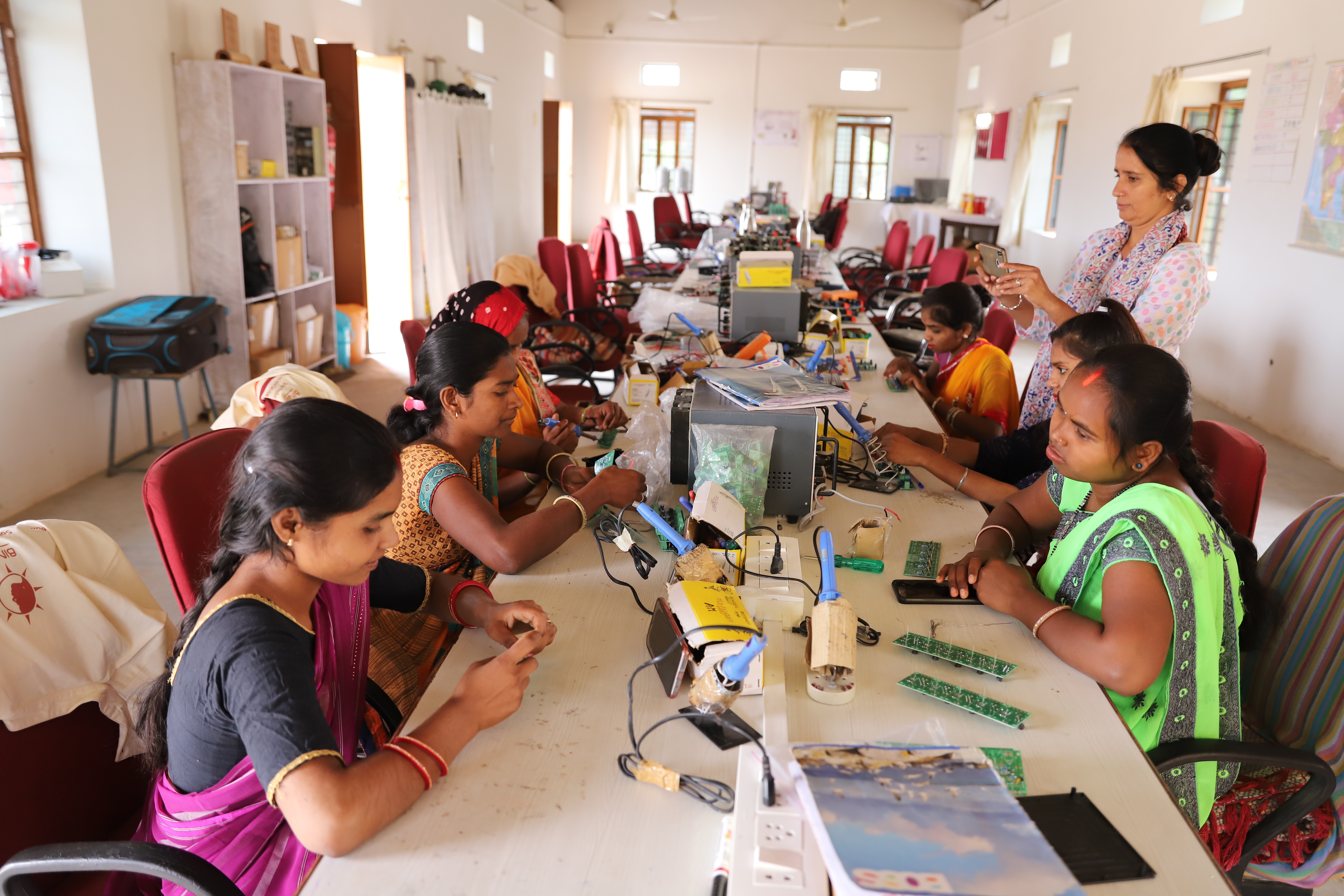
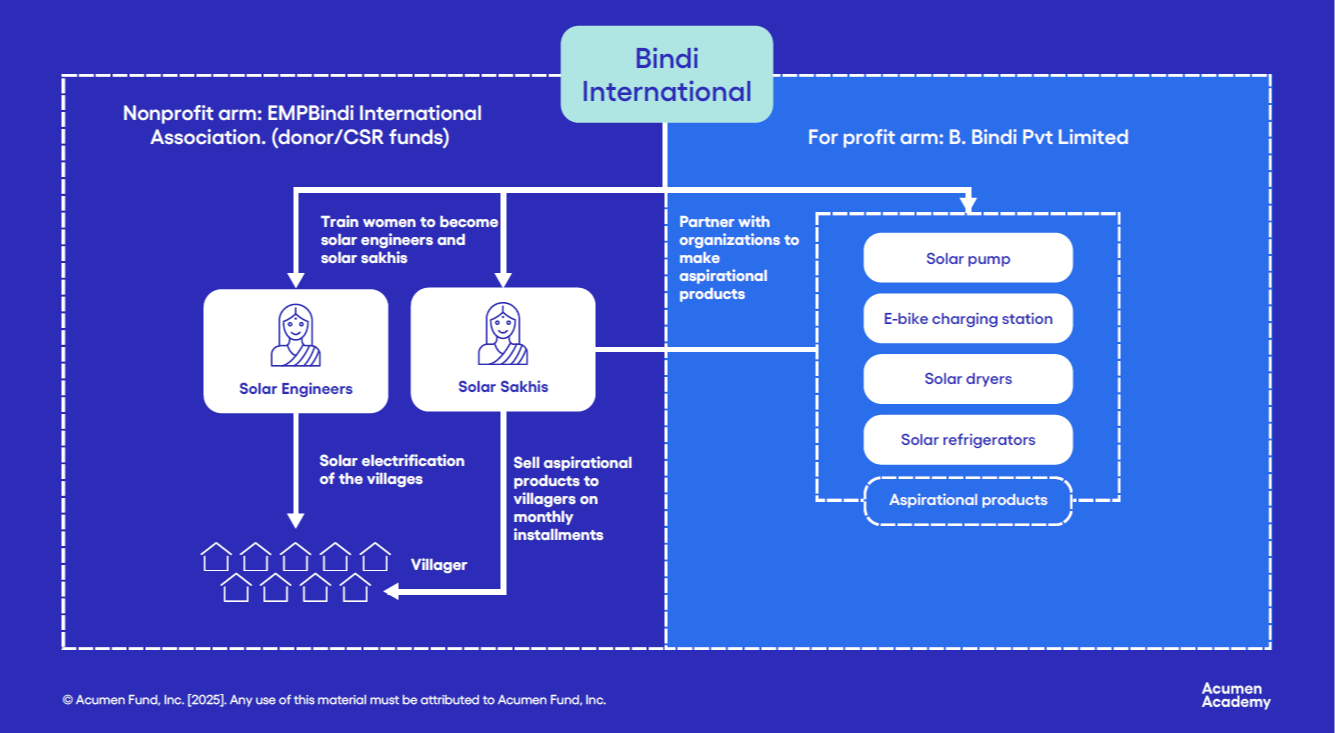
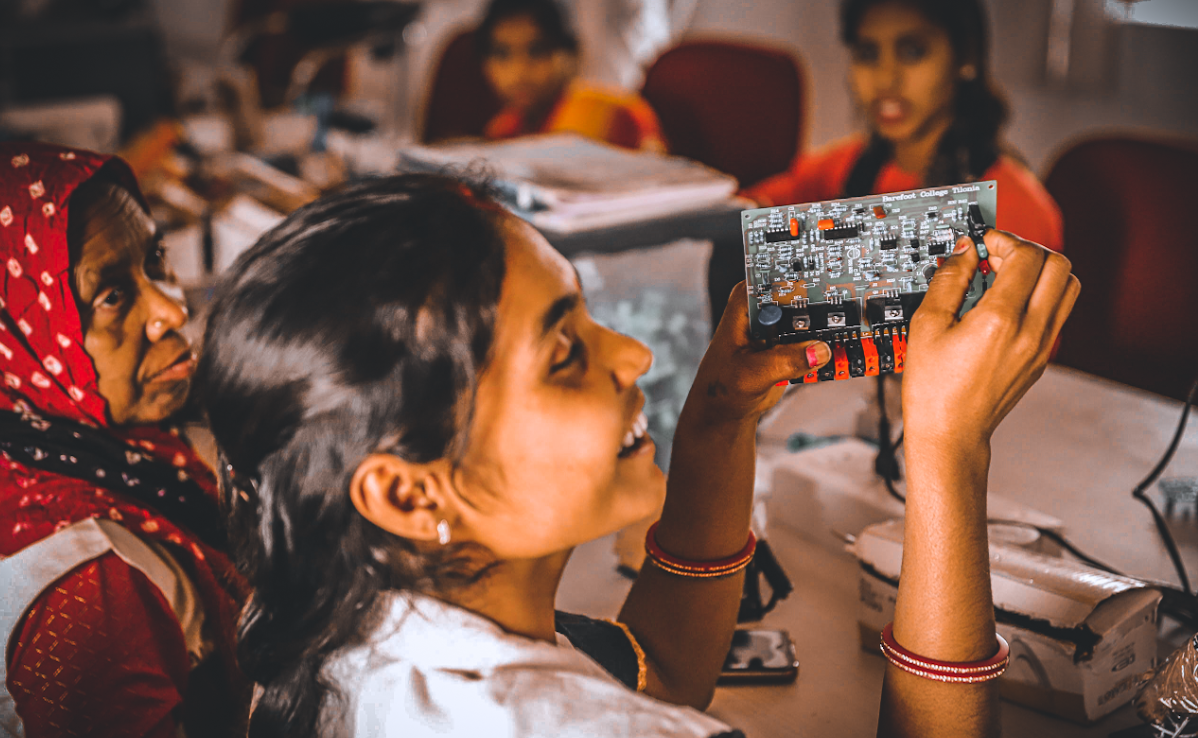
Bindi’s model centers on training women to take on two key roles: Solar Engineers and Solar Sakhis.
Solar Engineers are village-based women responsible for maintaining basic home lighting systems in their village. They handle routine repairs and act as the local point of contact for these systems.
Solar Sakhis are women entrepreneurs who work across villages to sell larger, more aspirational solar products (such as solar pumps, dryers, and refrigerators). They focus mainly on sales, customer coordination, and follow-up support.
Women can move/interchange between Solar Engineer and Solar Sakhi roles depending on their mobility, interests, and goals. Together, these women ensure that energy systems remain functional while communities can also access solar products that support livelihoods. Their local presence builds trust, keeps systems running, and strengthens repayment.
Bindi’s nonprofit arm, EMPBindi International Association, uses donor and CSR funds to cover basic household electrification and to train Solar Engineers and Solar Sakhis.
The for-profit arm, B. Bindi Pvt. Ltd., sources or produces aspirational livelihood tools (such as solar pumps, refrigerators, and microgrids) either in-house or through partnerships with organizations that want to work in rural areas and with women - often Acumen-network organizations willing to share technical blueprints and help train women.
Solar Sakhis, and in some cases Solar Engineers, sell these aspirational products to Self-Help Groups (SHGs), farmers, and local micro-enterprises for livelihood activities. Aspirational products are offered on EMIs aligned with seasonal cash flows. Solar Engineers and Solar Sakhis together support last-mile sales, installation coordination, and ongoing maintenance and repair.
Impact of revenue: Unlike donor funding, which pushed breadth (new villages), revenue has allowed Bindi to deepen impact where demand already exists. The model ensures that community requests for aspirational products are met sustainably.
Revenue split: Currently, about 80% of Bindi’s funding comes from donors, with 18-20% generated through revenue. Their goal is to reach a balanced 50/50 model, ensuring resilience and community-led growth.
Key challenges
Psychological and philosophical shift
Moving from philanthropy to a revenue-generating model required a mindset change that not all partners welcomed. Many partners, long dependent on donor funds, were uneasy with what they saw as a “transactional” approach. Charging money from villagers felt at odds with their service-driven ethos.
Harsh and his team envisioned an enterprise-driven model, one that required supply chains, marketing, logistics, and after-sales support. But while they pushed for depth – helping communities invest in livelihood-enhancing products, some partners preferred to stay with breadth – expanding through donor-backed programs. These philosophical differences led to conflict.
Eventually, Bindi chose to collaborate with new, more enterprising partners, clarifying that sustainable development required combining social and economic approaches.
Customer defines value
Bindi assumed that community willingness to pay (60% said yes in surveys) would translate smoothly into sales. In reality, entering a commercial market meant competing with cheaper alternatives.
After years of philanthropic work, the team was in a “best quality only” mindset. For example, they insisted on supplying industrial-grade wires even when households said they preferred cheaper local versions that met their needs. What Bindi viewed as “substandard” was, for customers fit for purpose.
The same friction showed up in delivery. Under philanthropy, sending products after two months was acceptable. As a business, families lost interest or spent the money elsewhere, if an order wasn’t delivered within ten days. The entire supply chain had to be reworked.
The lesson was humbling: in a market, value is defined not by providers, but by what customers are willing to pay for, and when. To adapt, Bindi retrained its supply chain team with external support, streamlined delivery timelines from months to days, and learned to balance affordability with reliability.
Don’t chase every idea
Bindi’s strength had always been deep listening before moving to design of solutions. But when the team heard repeatedly that women faced mobility challenges, they jumped headlong into e-mobility without pausing to ask deeper questions.
After eight months of development, the e-bike pilot failed almost immediately. The bikes were heavy, culturally misfit, and didn’t feel reliable to the very women they were meant to empower. As Harsh recalls, “We had deviated from what we did well, and the community taught us very swiftly that this would not work.”
The experience reminded the team that not every problem needs their solution. Their comparative advantage lay in community-trusted energy products, not in tackling every new issue that surfaced.
When Bindi moved from surveys to sales, they discovered that “value” meant something different to families than what the team had assumed. It wasn’t about the best wire or the strongest product, it was about what fit people’s needs, budgets, and timelines.
Reflect on your work: might there be a gap between what you believe matters most and what your customers actually value?
The impact
For Bindi, impact went far beyond electrification metrics and donor reporting. The shift enabled the organization to respond more proactively to community needs while supporting the growth of sustainable rural livelihoods.
Between 2015 and 2025, Bindi (working through 41 partner organizations across more than 19 states) electrified over 7,300 households in 746+ villages. Over this period, the program trained and engaged 214 Solar Engineers and 624 Solar Sakhis, and established 51 Rural Electronic Workshops (REWs). These local hubs enable Solar Engineers to deliver ongoing repair, maintenance, and troubleshooting services, ensuring system reliability long after installation.
Beyond basic electrification, Bindi International has sold around 7,900 solar products, expanding access to affordable, clean energy. The program also generated meaningful economic opportunity: Solar Engineers earned an average monthly income of ₹5,500 through maintenance and service work, while top-performing Solar Sakhis earned between ₹6,000 and ₹8,500 per month, strengthening household incomes and advancing women’s financial independence in rural communities.
Collectively, these efforts are projected to prevent nearly 4,650 tonnes of CO₂ emissions over the lifetime of the systems.
Lessons from Bindi’s evolution
As Harsh reminds us, lasting change comes from three things:
Deep community understanding
Knowing the local context enables you to connect meaningfully with people and gather real insight into where and why a product or program may–or may not–work.
Strategic collaboration
Partner with organizations already developing community-focused products as they bring valuable expertise in product design and implementation, helping translate social intent into practical, scalable solutions.
Genuine dialogue
"You have to actually ask them, do you really want to do this? Do you understand what it will entail?" Harsh emphasizes. Being transparent about expectations and challenges ensures that participation is informed and voluntary, not imposed. Otherwise, as Harsh warns, “you risk becoming a burden rather than a support.”
→ Bindi's journey reminds social entrepreneurs that business models aren't set in stone. Listening to communities may inspire the shifts necessary for sustainable impact.
Key takeaways
Communities you serve may be ready for more than philanthropy, they might be both willing and eager to pay for products or services that improve their livelihoods.
Revenue is more than finance, it creates the freedom to go deeper, invest in ecosystems, and pursue the impact you believe matters most.
In a market, value is defined not by what you offer, but by what customers choose to pay for and when.
Stay close to your strengths, and don’t chase every problem just because the need exists.