How it started
In 2011, bank manager Teresa Njoroge was wrongfully imprisoned for a financial crime she didn’t commit. While serving the one-year sentence with her infant daughter, Teresa discovered that the women around her were also victims – not of wrongful imprisonment, but of a lifetime of unequal opportunities and “the criminalization of poverty.” Teresa, an Acumen Fellow, explained:
“It starts with an education system whose supply and quality is not equal for all (...) Then the lack of economic opportunity pushes these women to petty survival crimes,” such as selling home-brewed alcohol or hawking wares in the street without a license.1
Under Kenya’s penal code, if an offender cannot afford to pay the fine for a petty offense, they must be incarcerated. Then after serving their sentence, they face even greater hurdles to formal employment, as they now have a criminal record. The result is that many poor and marginalized women are trapped in a “revolving door,” repeatedly imprisoned for doing what they must to survive.
The dehumanizing experience emboldened Teresa to found Clean Start Africa, a nonprofit that helps women impacted by the criminal justice system reintegrate into society through supportive peer groups and pathways to dignified employment. This second chance is critical for both the women and their children, as most imprisoned women in Kenya are the sole breadwinners of their families.2 As of 2025, Clean Start Africa has delivered psychosocial support and hygiene kits to more than 10,000 imprisoned women, and hundreds have participated in job training and income generation opportunities through the nonprofit’s program.
For most of its 10-year history, Clean Start Africa relied on grant funding to carry out this mission. But when grants proved to be too restrictive and unreliable to tackle the complex problem of reintegration, Clean Start Africa piloted an earned income model to generate revenue while strengthening the women’s independence. The new funding stream has taught the team lessons about managing change, and how the right model can deepen a nonprofit’s impact.
1 Njoroge, Teresa. (2017, December 4). What I learned serving time for a crime I didn’t commit [Video]. TED Talks. https://www.youtube.com/watch?v=y1yK36RMyRE
2 Featured Grantee Fact Sheet. Together Women Rise. Access in July 2025. https://togetherwomenrise.org/programfactsheets/clean-start-africa/
Journey to choosing the model
Clean Start Africa is a pioneer in offering rehabilitation and reintegration programs in Kenya. Their program begins inside prisons with 12 weeks of mentorship and basic vocational training to prepare women for life on the outside. Then immediately after release, participants are placed in peer-led support groups (“chapters”) and provided with seed capital and professional upskilling so they can launch micro and small enterprises.
When Clean Start Africa began its journey, the nonprofit relied on donations from individuals, faith-based organizations, small family foundations, and prize competitions. Although the donor base was growing slowly through referrals, Teresa found herself "continuously searching” for the next funding opportunity.
To fill the gap between grants, Clean Start Africa experimented with earned income by offering consulting services like corporate team-building workshops. But it was challenging to balance consulting while building the core programs. Then, in 2023, the team had a lightbulb moment. Teresa adds:
“We had trained so many women in prison, then upskilled them on the outside, yet getting jobs was still very difficult for them (...) That’s when we came up with the idea of setting up income-generating hubs.”
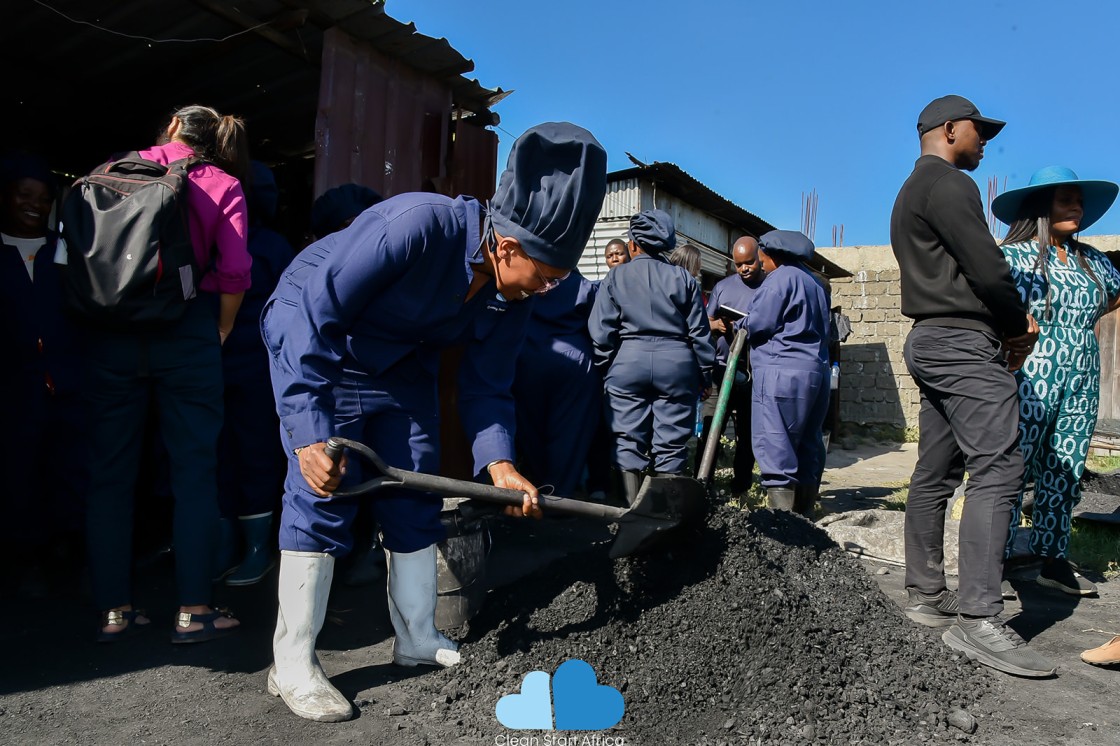
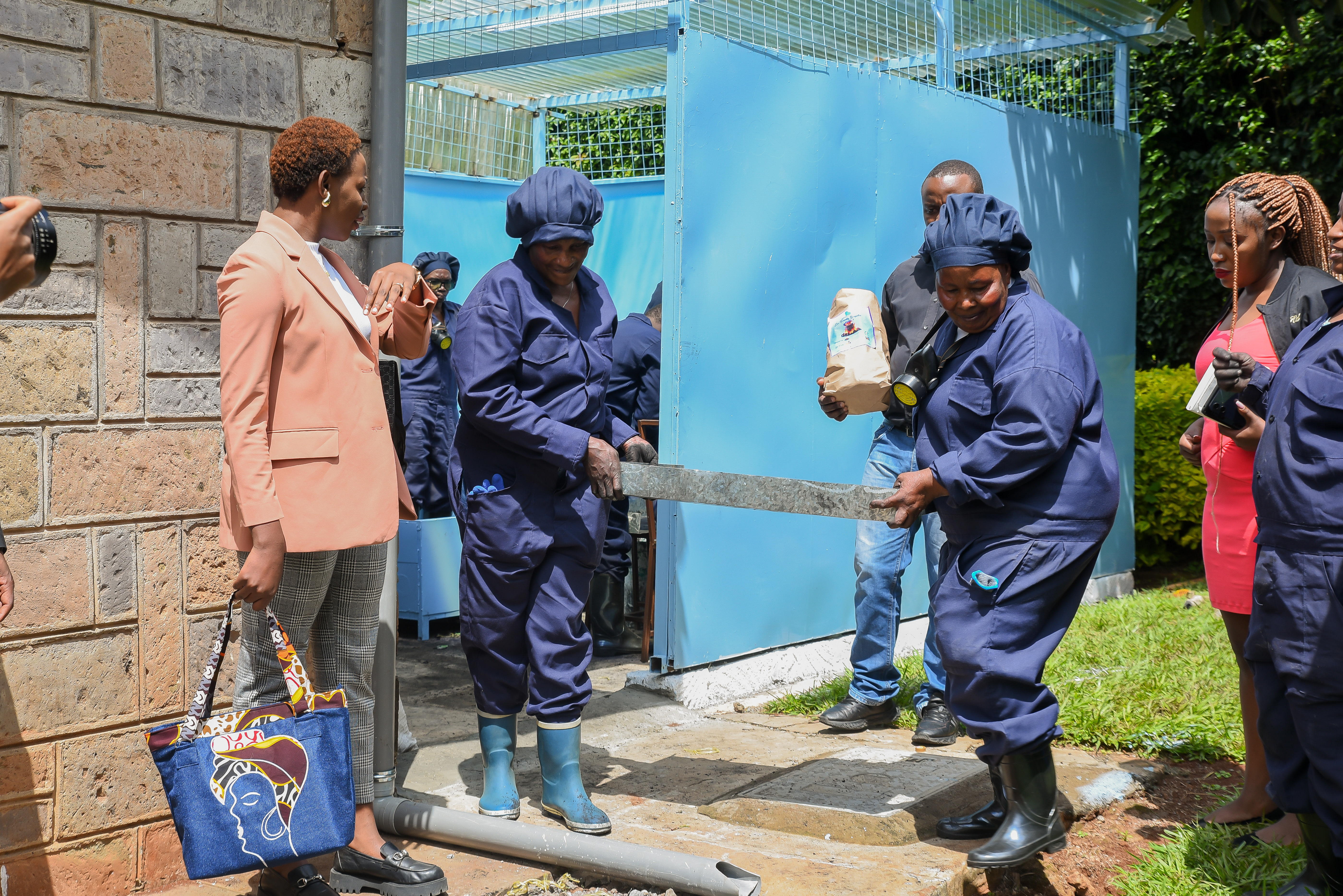
Teresa explained that, after release from prison, many of the women had received professional training from industry specialists in salon services, textile production, and manufacturing of eco-friendly briquettes for cooking – sectors intentionally chosen because they had low barriers to entry and didn’t require criminal background checks. Furthermore, Teresa observed that some women had gone on to achieve independence and were ready to “pay it forward” as mentors and trainers.
This laid the foundation for a mission-aligned, embedded earned income idea: establishing profitable businesses that leveraged Clean Start Africa’s network and sectors of expertise to provide sustainable, dignified employment while earning revenue for the nonprofit.
How Clean Start Africa’s earned income model works
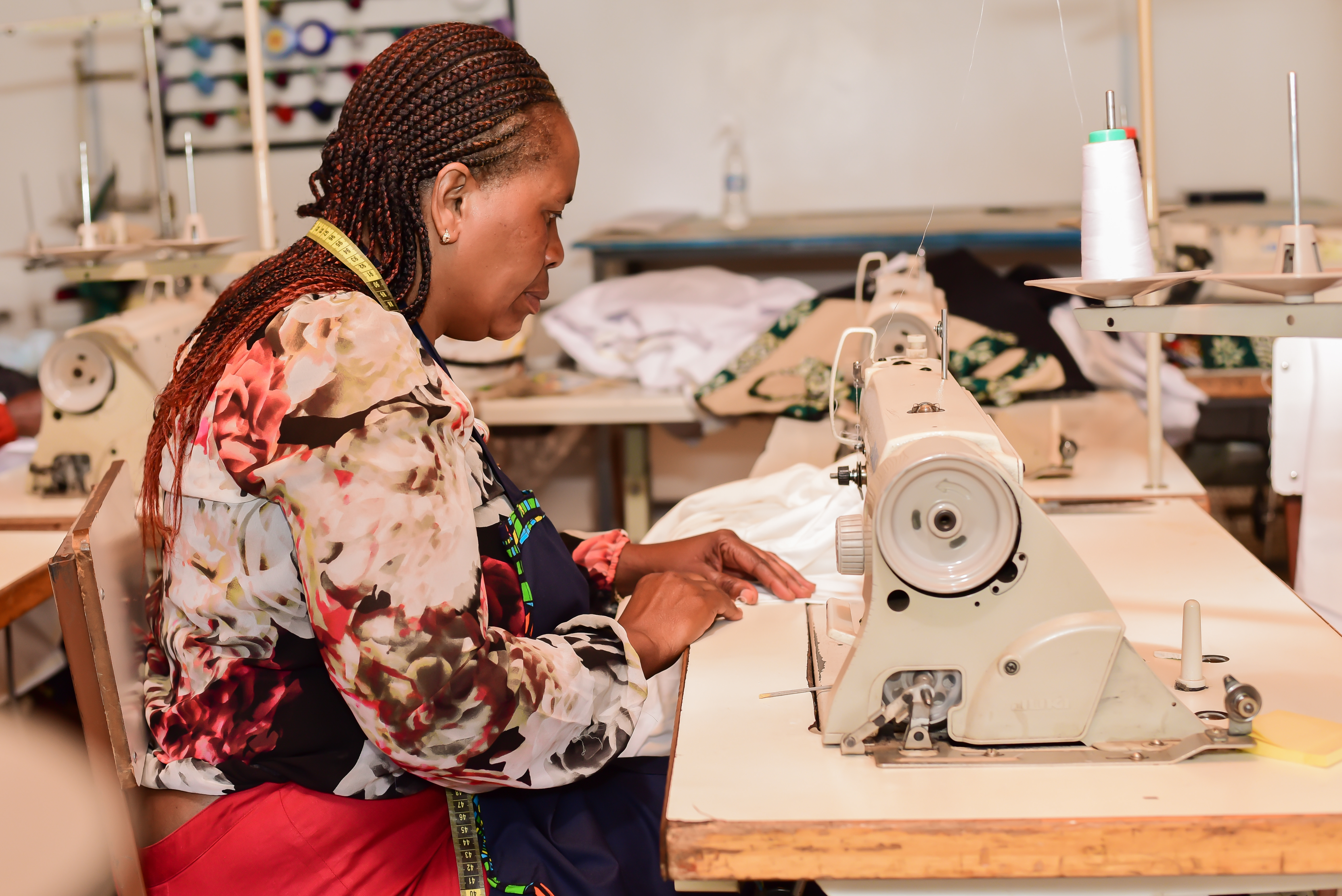
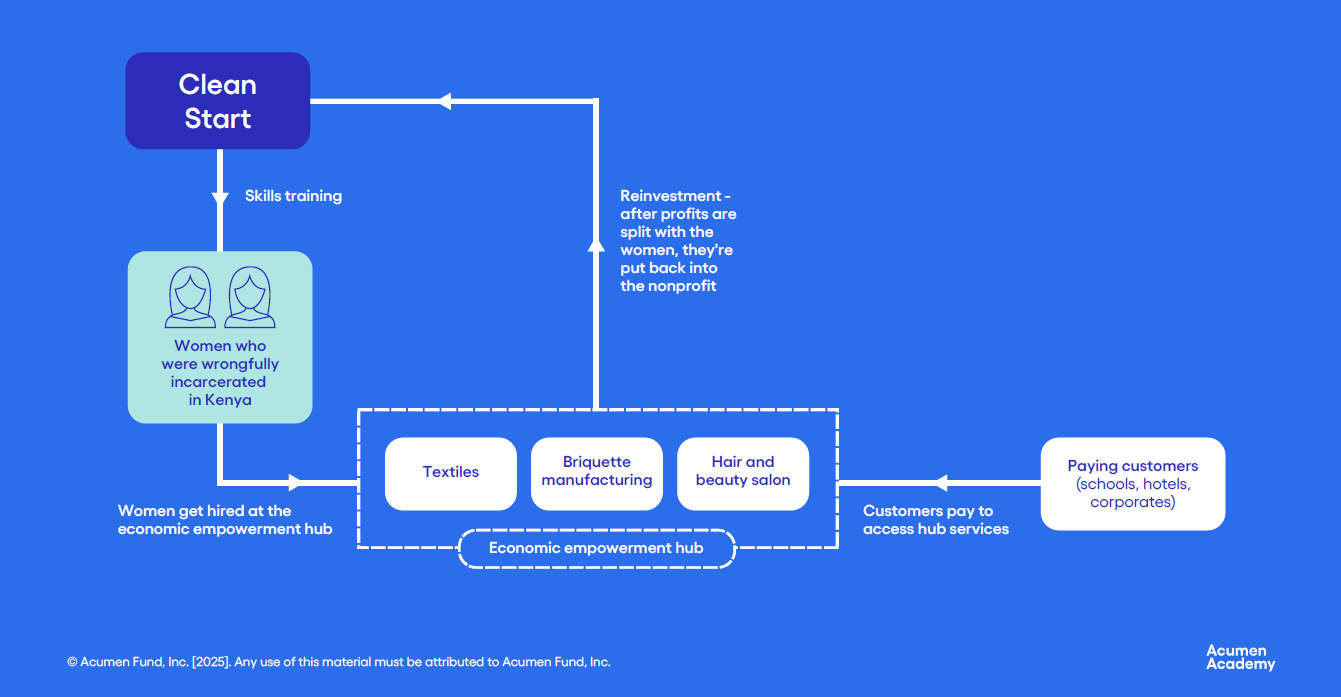
Upfront costs: Clean Start Africa invests startup capital in the facilities and equipment for each “economic empowerment hub.” There are currently 3 hubs: textiles, eco-friendly briquette manufacturing, and a hair and beauty salon.
Staffing and operations: Clean Start Africa has dedicated teams to supervise the daily operations of the hubs and to market their products and services. The nonprofit also partners with leading training academies and pays a stipend to program alumni who serve as trainers.
Impact: The women employed by the hub earn income based on their output (e.g., individual salon services or piece work for textiles and eco-friendly briquettes).
Revenue: After the women are paid for their output, the remainder of the profits are split between Clean Start Africa and invested back into the hub’s operations. Clean Start Africa also earns revenue from outside individuals who pay to be trained at the salon.
Clean Start Africa prices its products and services through benchmarking and customer feedback. The nonprofit partners with leading academies to train the women in industry skills, and then prices and positions its products and services to reflect that level of quality.
The sales and marketing team, who are former beneficiaries of Clean Start Africa, are responsible for building a pipeline of institutional customers like hotels, hospitals, and schools. The mission is fundamental to Clean Start Africa’s branding and value proposition: Every product comes with a tag that features the nonprofit’s story and the name of the maker. Many donors and partners have converted to paying customers of the economic hubs, purchasing school uniforms or branded tote bags for their corporate conferences.
→ Today, the textile, eco-friendly briquette, and salon hubs contribute about 10% of Clean Start Africa’s annual revenue, while philanthropic funding makes up the remaining 90%.
Key challenge deep dive
Identifying business opportunities with low barriers to entry and high margins
Clean Start Africa decided to focus its “economic hubs” on textiles, eco-friendly briquette manufacturing, and salon services because they were a good fit for the women’s skills – but also because there were fewer barriers to entering the market.
Textile and eco-friendly briquette manufacturing have minimal ongoing expenses after the initial investment in equipment, explained Teresa. Although the salon has higher ongoing expenses, Clean Start Africa found a partner to fund scholarships for the women’s training, which has helped make the business model sustainable.
In contrast, one of the women in the program was an especially skilled cook, so Clean Start Africa hoped to invest in a restaurant hub. But the team quickly realized they weren’t prepared to meet the restaurant industry’s demanding health standards. For now, Clean Start Africa is focusing on its textile, eco-friendly briquette, and salon hubs, while seeking out new opportunities.
“Most of the business ideas came naturally because these are activities or skills that the women engage in while in prison,” added Teresa. “But I must confess that they are low margin activities. So we still have a dream of getting into high margin spaces.”
Preparing for pushback and managing change
As Clean Start Africa embarked on its earned revenue strategy, many of the program participants and nonprofit staff were surprised by the new direction.
“[The women] have been used to getting things for free from Clean Start,” said Clean Start’s social impact lead, Sarah Nasimiyu. “Now we are changing the narrative [and] saying you have to play a part in your own transformation story. It will not be charity all the time.”
This initially led to some pushback: Some chapters refused the offer of equipment when they were told they had to pay it off over time through a percentage of their sales.
“But then a majority leaned in,” Teresa said. “We’re continuing to do ‘sensitization’ to show them why this way of running our operations makes sense. But I must admit, it has been a difficult time.”
To build its capacity for operating the hubs, Clean Start Africa also went through an organizational restructuring, bringing in new leaders and board members who were experienced in monetizing nonprofit solutions and bringing them to scale. Emotionally for Teresa, this required letting go of some staff who weren’t aligned with what Clean Start Africa needed in its next stage of growth.
Closing reflections
Understanding your readiness for earned income
“Timing is crucial,” said Teresa. “If we had introduced this revenue model in the beginning years of building our foundation, it would have broken. We wouldn’t have gotten it right.”
For Clean Start Africa, a successful earned income strategy required “the right people with the right mindset.”
Gaining relief from donor dependence
Building and iterating an earned income model has given the leaders a sense of relief and pride.
“I’m more confident in the kind of organization that I’m leading,” said Teresa. “We’re building something that’s sustainable and replicable. I cannot express the relief of knowing that it’s possible for us to earn revenue beyond what we’re getting through grants.”
“Donors might not be with you for a long time,” added Teresa. “They could change their priorities or even the geographical areas where they work. We need to have a safety net so that we can continue doing this work.”
Deepening customer impact via new models
“The earned income strategy has inspired new and better ways of serving the women in Clean Start Africa’s programs,” explained Teresa.
“Launching our for-profit side has helped us get innovative,” said Sarah. “We’re looking for solutions that are customized for the people that we work with. We’ve also opened ourselves to working with partners who want to support our profits and offer their pro bono services. It’s a new level of growth.”
Which of your nonprofit’s stakeholders might oppose a pivot to earned income?
How could you anticipate and address their concerns?
Key takeaways
Start with a strong foundation: An earned income model can only succeed when your nonprofit’s core mission, programs, and operations are strong.
Consider market access: Nonprofits exploring earned income should prioritize markets they understand and can realistically access, where entry barriers like costs and regulations are manageable.
Prepare for pushback: Pitching an earned income model can provoke skepticism or resistance from leadership, staff, board members, and beneficiaries. Invest time in explaining your vision and why the model will lead to greater impact.
Make the hard decisions: Earned income models often require bringing on new teammates and board members with the right business acumen, or letting go of those who aren’t aligned with your next stage of growth.